Hi everyone!
Back again with another major update.
Trouble Brewing, pt.2 picks up where part 1 left off. This update focused a lot on behind the scenes work, adding a lot of needed structure to the brewing system.
You’ll find a lot of the new features in this post are less refined than usual. In my last post I talked about getting prepared for play-testing. The first playable demo of Flask & Barrel will be the Alpha release. I am blitzing towards that release, with a full set of playable features. Post-alpha updates will focus on adding polish.
Let’s start off by going into Liquids and Brewing Machines. Being a brewing game, these systems are at the core of everything. Brewing Machines are objects in game that can create and transform liquids. Liquids have several properties to control what can and can’t be done with them. Here are the most important ones:
- Category: Liquid Category includes things like Wort, Mash, Ale, Lager, Spirit, etc. This helps determine what categories liquids can transform into. For example, Worts can be fermented into Ale. More on this later!
- Proof: Proof is how much alcohol is available in the liquid. Important for Distilling.
- Sugar Level: This value determines how much sugar is in the liquid. Important for Fermenting.
- Value: Every liquid has a value, determined by the ingredients and how much work you put into it. But there’s a catch! Incomplete brews (like Worts) are worth very little. So, its always worth it to see the process through to the end!
To help us move these liquids between machines, we have new object in the game, the Pump Station.
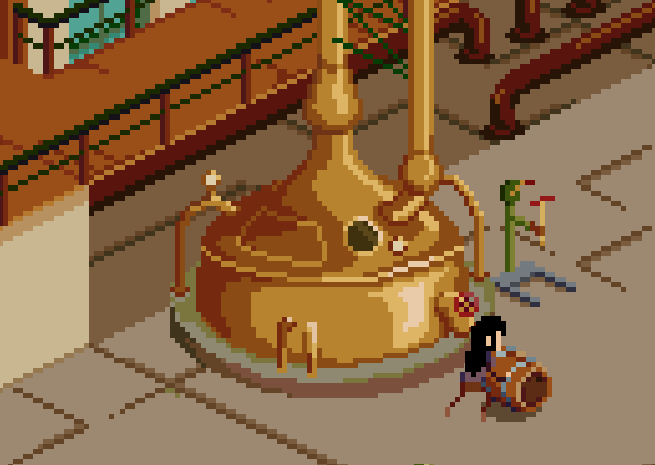
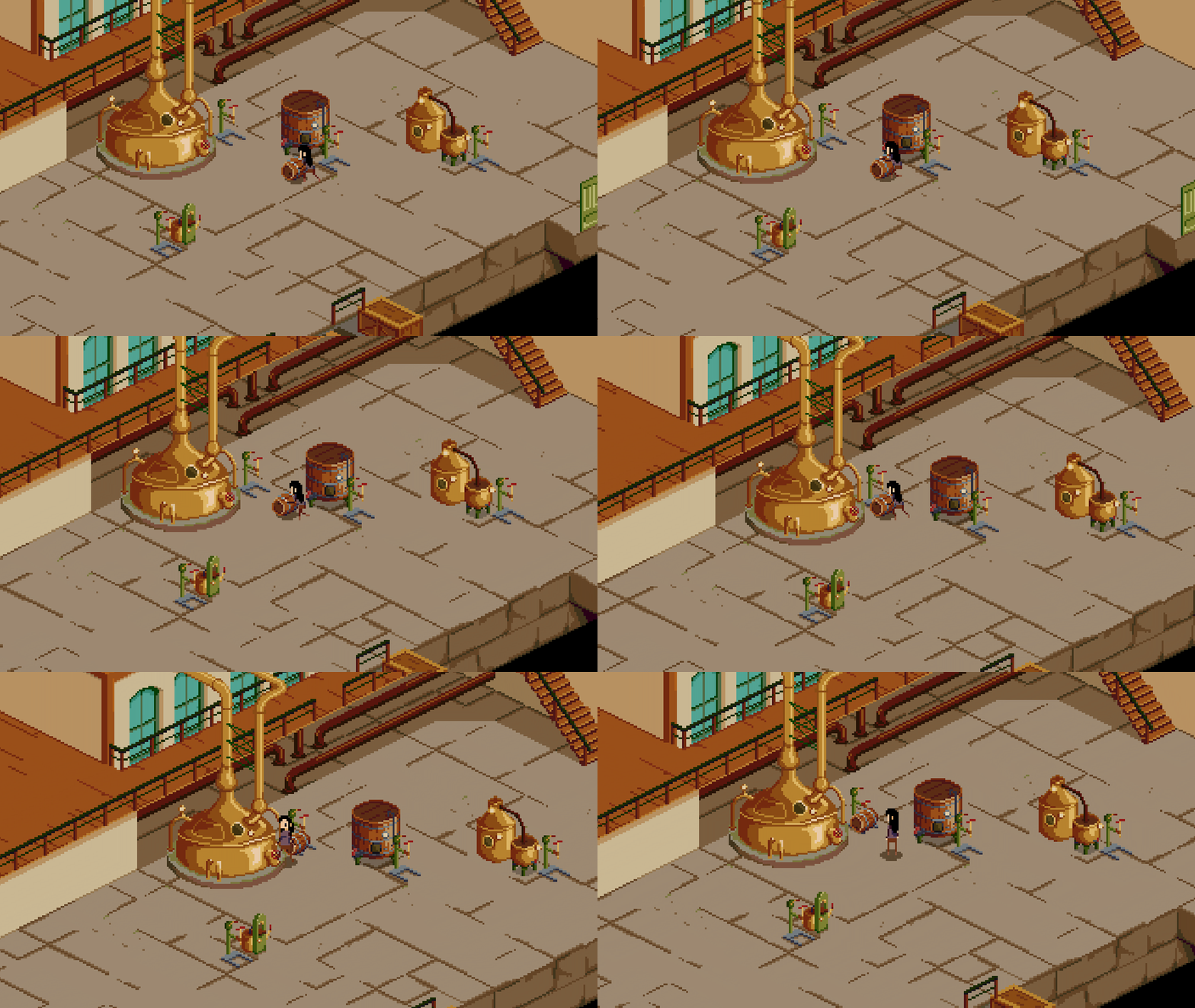
The Pump Station is an add-on for brewing machines that lets you transfer liquid from or to a barrel. To use the pump station, roll a barrel over to the station and let it go. When its close enough, the barrel will automatically nudge itself into position and latch onto it.
Once attached, you can open up the interface to see the liquid gauges.
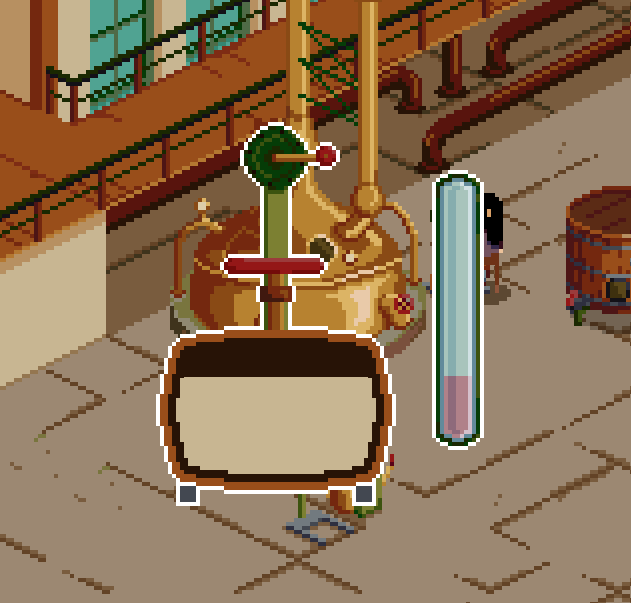
The barrel’s current volume is indicated by the fill visible in UI. The gauge on the right hand side displays the liquid available in the machine the pump is attached to. The crank on the top lets you pump liquid into or out of the barrel.
This is the main way that liquid is moved between machines for now. In the long term, I have plans for a plumbing/piping system. Something with valves and switches to help automate brewing towards the late game. But that will be saved for a later update!
This new feature also takes the place of the dynamic hose system discussed in Part 1. I think barrel-based transfers are a little more on brand for Flask & Barrel.
This new Pump Station helps support some new brewing machines that are now available!
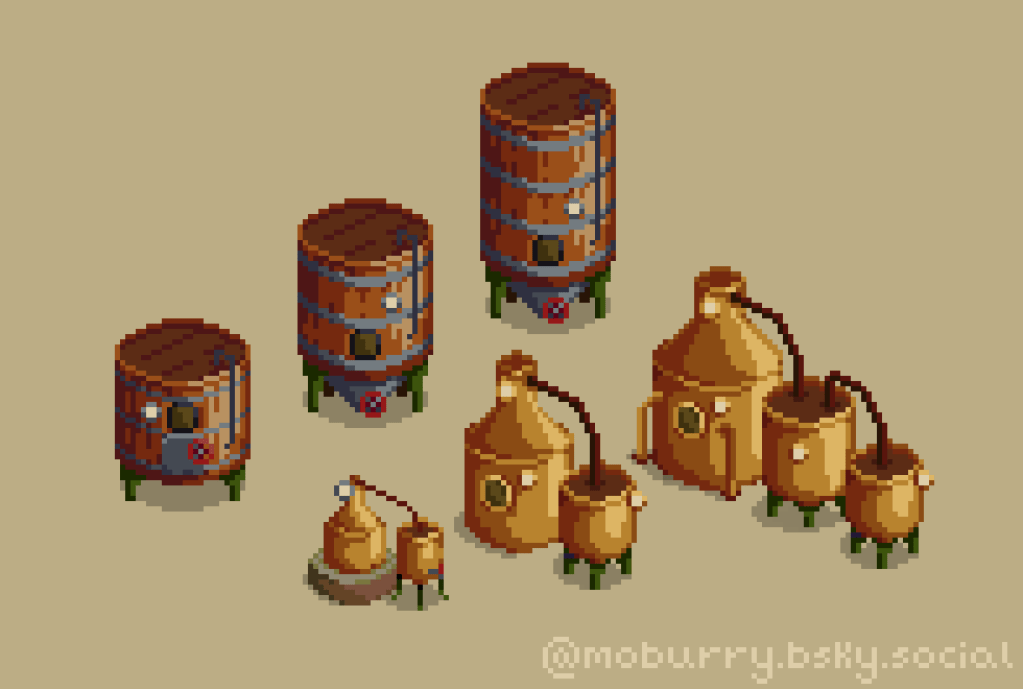
These machines have upgrades, hence the multiple sprites. For now, I just focused on a single tier. Future updates will fill in the gaps with support for upgrading machines.
Before we get into those, lets talk about some work being done on the Kettle. The Kettle has gone through some rework to make it easier to use.

The Kettle’s main function is to create a liquid based on the input ingredients. Here are some of the combinations it supports now:
- Fruits and/or Vegetables -> Mash
- Grains -> Wort
- Herbs and/or Flowers -> Tonic
- All others -> Elixir
For anyone who has done some real life brewing, some of these terms will be familiar. Worts are a precursor to different varieties of beer. Mashes are the precursor for heavier liquors. Tonics are quick and easy herbal infusions. Elixirs here serve the function of the “catch all” category. These will have a lower value, but they don’t care what you make them out of. This allows you to brew up some “quick cash” and burn through ingredients that are taking up space.
Next up, we have the Fermenter.
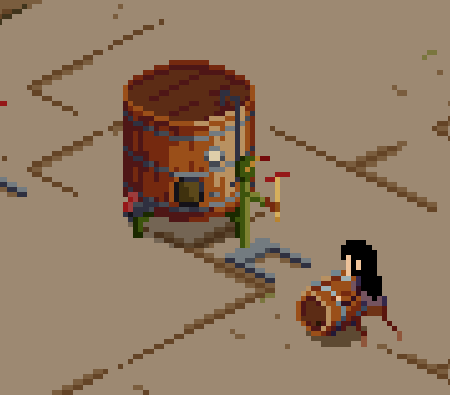
The Fermenter is a large wooden barrel that you can use for fermenting by adding in some yeast!

There are a few varieties of yeast that help the Fermenter decide what its going to make. The 3 varieties we have now are:
- Ale Yeast
- Lager Yeast
- Distiller’s Yeast
These yeasts have different sugar requirements. Like in real life, yeasts eat sugars and turn them into alcohol! Beer yeasts don’t need much sugar to get going, but can’t produce a very high proof. Distiller’s Yeast needs a lot more sugar, but can create a much higher proof.
The sugar level of the liquid in the Fermenter is signified by the meter below the viewing window.
When you add yeast and a eligible liquid into the Fermenter and start it up, the liquid starts bubbling away.

The Fermenter uses the input liquid category along with the yeast to determine what to brew. Here are the current supported transformations:
- Wort -> Ale Yeast: Ale, Lager Yeast: Lager, Distiller’s Yeast: Wash
- Juice -> Ale/Lager Yeast: Wine, Distiller’s Yeast: Liqueur
Note that things like Tonics and Elixirs don’t have enough sugar to ferment, so the process cannot start for them.
Now that we’ve talked about Wort, lets move on to Mash. To use this liquid, you’ll need to use the Still.
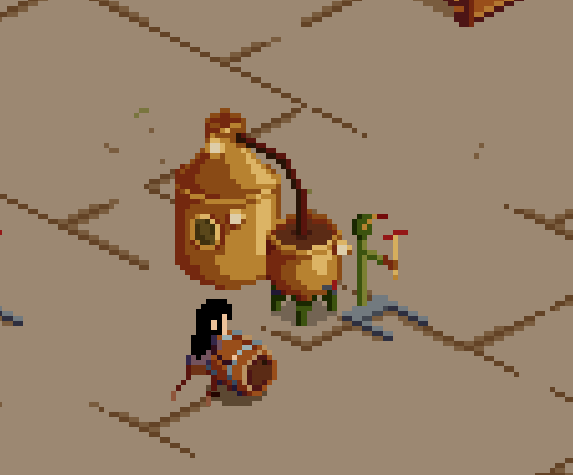
The Still is a simpler machine with a very simple (familiar) interface. The Still distills the liquid inside it, concentrating it into a lower volume, but a higher proof. To be distilled, the liquid needs to have a minimum proof. After all, you can’t distill alcohol that isn’t there. This is signified by the meter below the interface.

Here are the currently supported transformations:
- Ale/Lager -> Spirit
- Wine -> Brandy
- Wash -> Spirit*
- Liqueurs -> Schnapps
In the still, Spirit becomes the “catch-all” category, representing high-proof, distilled liquids that don’t have an exact home.
Wash will work a little differently. Something I left out is that liquids also know what ingredients they are made out of. When distilling a Wash, the Still takes those ingredients into account and creates a liquid based on that. For example, a Grain Wash becomes Whiskey. While it works now, I need to add some more items into the game to really take advantage of it. There will be more on this in future content expansions.
The final machine I want to show off today is the Bottler. This one is pretty self explanatory. The Bottler takes liquids from barrels and lets you pump them into flasks! Flasks will be sell-able in the shop for a good mark up! These will also be your only way of delivering customer orders.

And just like that, we have a Flask of Lager!
This update solidifies what I am calling the “basic brewing” features. As of right now, you can take ingredients and really make something with them, like the Lager we made (and bottled!) above. Future updates will introduce “advanced brewing” with new machines and new mechanics.
What’s Brewing?
After powering through brewing for so long, I am ready to move on to something else for a little while. The next update, Open for Business will focus on the shop-keeping and economic aspects of the game.
Last post I made I said that Open for Business would allow for some real play-testing. While I think this is true, I don’t think it would be a very complete experience. Instead, I’ve decided to keep the game a little longer and save play-tests for the Alpha Release.
I see Alpha as a “Core Feature Complete” development state. There will still be plenty of content/mechanics/balancing missing, but, what’s important is you can interact with all the main features. Things like brewing, shop-keeping, and customizing your brewery.
To keep myself more accountable, I’d like to share my roadmap to Alpha. Keep in mind, this is very rough and subject to change and reshuffling.
Alpha Release Roadmap
v0.11.0 – Open for Business Q2 2025
- Full shop
- Ability to sell flasks from store shelves
- Customers
- Daily Shop Report
- Currency
- Animations Overhaul
v0.12.0 – Pipe Dream ~Q3 2025
- Boiler and Power System
- Plumbing system
- Brewing system polish
- Machine Upgrades
v0.13.0 – Trade Winds ~Q4 2025
- Expanded Town
- Marketplace
- Vendors
- More consistent sound and music
Alpha v1.0.0 – Cleaning Up ~Q1 2026
- Shop cleaning mechanic
- Content expansion
- New items, dialog, brewing machines, NPCs
- Bug Fixes
My plan right now is for v0.13.0 to be the last “Pre-Alpha” release, and the following update will be the first alpha release, Alpha v1.0.0. I won’t define that version too much. I want some of it to be a surprise, and a lot can change in the next few months.
That’s all that I’ve got! I’ll be back with Open for Business soon, and then we will be back on to brewing again!
Thanks for reading!
– Nick
 Flask & Barrel