Hi everyone,
I’m back! I’ve officially broken the record for longest time between blogs. If you’re interested in more frequent, less formal updates, make sure you join the Discord!
I’ve got a lot of fun stuff to share! Before I get into it though, I want to talk about changes that are coming to this project.
I’ve re-scoped Flask & Barrel to make finishing the game easier. Scope creep was affecting the main focus in recent updates, shifting from brewing to adventuring. From now on, the game world will center on the town, rather than a large world. There will be more emphasis on establishing consistent ingredient supply lines within the town, and processing them into what you need. Near-term updates will concentrate on the brewing and shop-keeping systems to really get the core game-play moving.
So, for this update I really focused on the logistics of brewing, and so here is Trouble Brewing, pt.1. For what feels like the millionth time on this blog, let me walk you through the new process of brewing in Flask & Barrel:
First, we have the kettle. We’ve seen the kettle before, but this go around its got more going on. I’ve added some hatches, dials and valves to make it feel more real and usable.
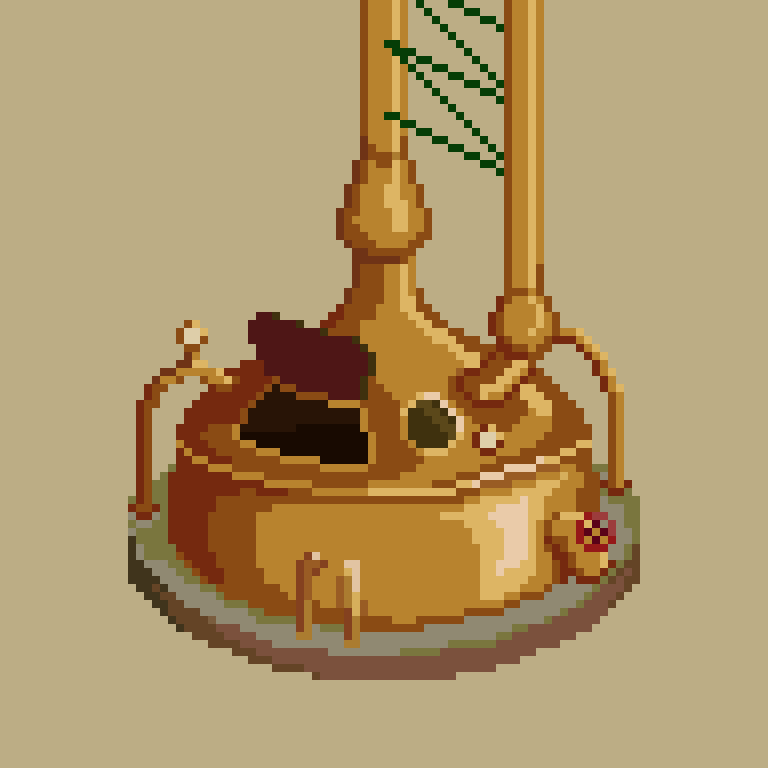
To use the kettle, you’ll first open the hatch by interacting with the left hand side. Here, you will find an interface with 3 item slots for ingredients.

Lets talk more about ingredients in Flask & Barrel. Ingredients are separated into categories, there are now 10 categories, ranging from Mushrooms and Herbs, to Minerals and Brewed Goods. Not all item categories are eligible to be ingredients.
A brief aside on ingredients. Ingredients will no longer be collected via large scale adventures like I previously outlined. Instead, you’ll collect ingredients by trading and bartering with the various merchants visiting the busy town. There will be a dedicated marketplace in the towns center to accomplish this. More on this in future updates!
What comes out of the kettle is completely dependent on what you put in. The mix of different categories is just as important as the mix of specific ingredients. For example, combining Flowers and Herbs categories would produce a tonic, while Mushrooms and Monster Parts categories would produce an elixir. These are what I am calling Brewing Categories, and this category determines what can be done later to enhance them.
I’m focusing on 4 Brewing Categories right now: Tonics, Elixirs, Worts, and Oils. Tonics and Elixirs are “early-game” categories, involving only one basic step – the kettle. Worts are the first mid-to-early game brew category, the precursor to Ales and Spirits.
The Oils category is Flask & Barrel’s equivalent to “Dubious Food”. It’s what happens when you try to make a combination that isn’t valid, like mixing Flowers and Monster Parts. They’re still sell-able and can fetch a good price (a la Snake Oil), but they can’t be processed any further, thus making your ingredients less profitable.
There is also a system for what I am calling Unique Brews. These are combinations of specific ingredients that you’ll be able to learn over the course of the game. These would have unique names, icons, effects and values.
When you place items in the kettle, if it is a known recipe/combination, the kettle will tell you right away. Otherwise it shows you that it is a new combination by displaying question marks, and it will be added to your recipe book once you brew it and establish what it is you’re making. This should help make experimenting more fun and less memory-based.

After loading up the kettle, you can now get the process started. You do this by filling the kettle with water, using the valve located on the right.
Once the kettle is full, it will automatically start bubbling away. Progress can be checked by interacting with the viewing window, which pulls up an interface that gives some brewing information (more on this interface in part 2).

Next its time to get that brew on the move. In Flask & Barrel, the main way of moving liquid around is by using… barrels! Located next to the kettle is a hose reel. The player can pick up this hose, plug it into a barrel, and fill it up.

Barrels aren’t an inventory item you can pick up and place, instead they need to be rolled around! Barrels slowly come up to speed depending on their mass, and if they hit a wall, they will bounce off.

Barrels are for storing, transporting and aging brews. They can also be used to sell brews in bulk. There is a specific area in the brewery where the player can place them to get picked up during the night (along with any other bits and bobs they want to get rid off). These will be picked up by a local exporter, who takes his own cut, reducing your profits. He also drops off some fresh barrels in exchange!

That’s as far as brewing goes for part 1. Part 2 is now in progress, so I will share some details at the end!
I am excited about this new brewing system, because it is the first stepping stone in “advanced brewing”. Not all Brewing Categories are going to be worth it to sell right away. In fact, few of them will be. Instead, (like I mentioned above with Ales) it will be your job to build and buy new machines and processing stations to further enhance your brewing abilities.
To account for this, the brewery has grown a bit!
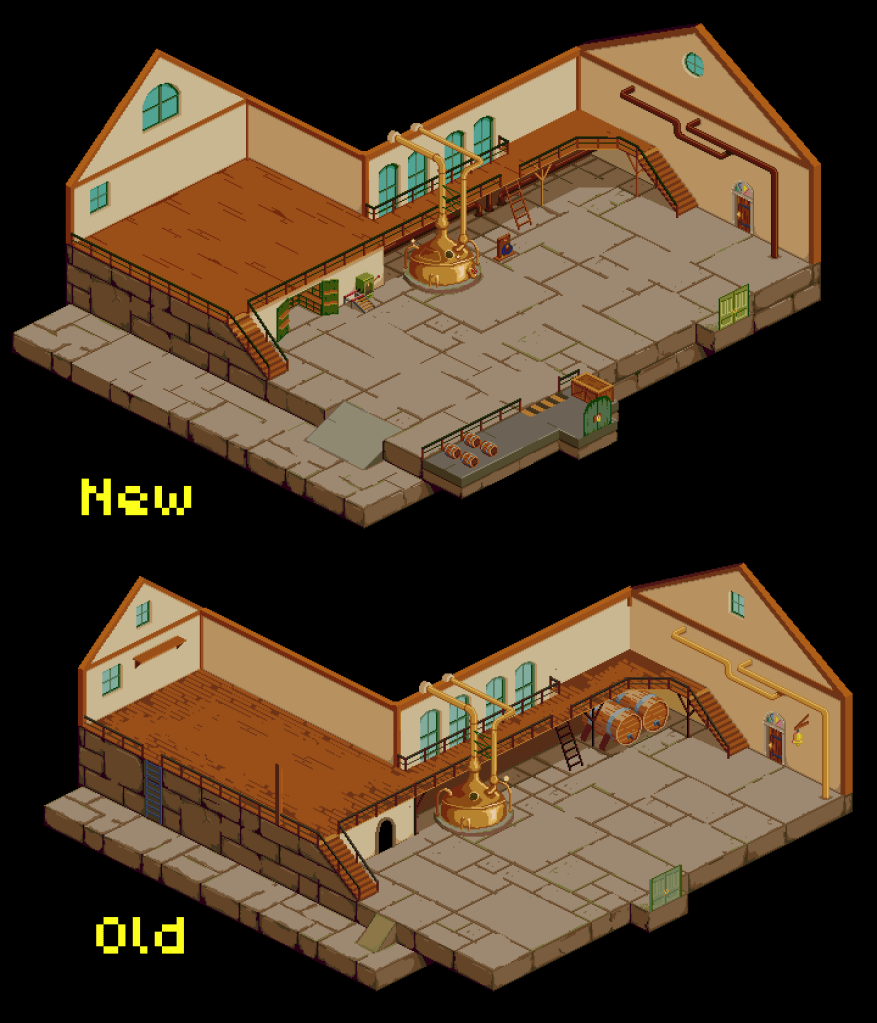
It might not look like much, but there is much more build-able space available now, and the new layout is much closer to the layout of the exterior.
Other Minor Changes
- Internal changes to the character states system, allowing more dynamic animations and interactions.
- Significant expansion of the surrounding town
- Hover highlights and labels on barrels
- Improved HUD
- Improved UI clarity
- Physics based pixel ropes
What’s Brewing?
Coming up next is Trouble Brewing, pt. 2. Where part 1 focused on Barrels, part 2 will focus on Flasks and expanding brewing. So here’s a teaser for that!

Flasks will be your primary source of income. Flasks are filled by bringing a barrel to a bottling machine and pumping the liquid into them. These flasks can then be sold directly in your shop or delivered to customers!
Part 2 will also include some additional early game brewing machines, the Fermenter and the Still for turning our Worts into Ales and Spirits. It should be exciting to see the system gain some depth.
Actual customers and shop mechanics won’t be part of Trouble Brewing, pt. 2, and will instead be saved for the next next version, v0.11.0 – Open For Business.
v0.11.0 is the first version I expect being ready for some (very rough) play-testing, so if you’re interested, be sure to join the Discord!
Thanks for reading!
– Nick
 Flask & Barrel